Complete Guide to Home Hummingbird Feeders: Selection, Use, and Maintenance

On a sunny afternoon, seeing a hummingbird gracefully perch on a hummingbird feeder is a dream scene for many gardening enthusiasts. Their metallic feathers, agile movements, and rapid wingbeats instantly bring life to the garden. Perhaps you’d like to try hanging a feeder in your home, allowing these little visitors to come and go occasionally. But then the questions arise: how do you buy a hummingbird feeder, how do you use it, and how do you maintain it? This article will provide you with a truly practical and actionable home guide.
1. Why use a hummingbird feeder at home?
Hummingbirds are among the fastest-metabolizing birds on Earth, requiring twice their body weight in sugar daily. Without a consistent source of nectar, they are prone to energy shortages during migration. The benefits of using a hummingbird feeder at home include:
- station.”Provide energy outside of the flowering season: When the flower source decreases, the feeder can become their “energy refueling station”.
- Observation and companionship: The activity of hummingbirds brings vitality to the yard and is a natural way to relieve stress.
- Educational significance: For children, observing hummingbirds is the most interesting starting point for understanding ecological balance.
However, it’s important to remember that the hummingbird feeder is not a substitute for flower sources; it simply helps hummingbirds survive periods of food scarcity.
II. Key points for choosing a hummingbird feeder: Appearance is not the most important factor.
When buying a feeder for the first time, many people are attracted by its beautiful design, but what really deserves attention is its structure and safety.
1. Hummingbird feeder capacity and shape: First consider the number of hummingbirds you have.
- Small capacity (8–10 ounces): Suitable for beginners and areas with fewer hummingbirds.
- Large capacity (16 ounces and above): Suitable for frequent bird visitors or users who find it inconvenient to change the sugar solution frequently.
- Tray feeders are easy to clean and less prone to leaks; bottle feeders are aesthetically pleasing but require more maintenance.
safer,A little tip: If you live in a hot climate, smaller hummingbird feeders are safer as the syrup is less likely to spoil.
2. Material Comparison: Glass Hummingbird Feeder vs. Plastic
- Glass version: More durable, less prone to odor residue, and has a premium appearance. The downsides are that it is heavy and fragile.
- Plastic version: lightweight and affordable, but prone to deformation and fading due to sun exposure.
- When choosing a hummingbird, cleanliness and convenience should be the primary considerations. Hummingbirds have small feeding openings, and residual sugar can easily breed mold.
3. Color and insect-proof design
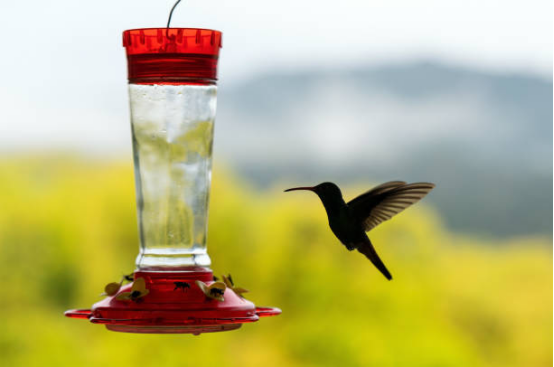
Hummingbirds are naturally attracted to red, so feeders with red lids will attract their attention more quickly.
However, try to avoid yellow or bright orange details, as these colors easily attract bees or wasps.
If your feeder doesn’t have an ant-proof device, you can add an “ant moat” to the hook to keep crawling insects away with a small amount of water.
III. Hummingbird Feeder Nectar Recipe: A Simple and Safe Recipe
Sometimes people think of using honey or red sugar syrup to attract hummingbirds, but that’s a common misconception.
A truly safe and effective nectar (sugar syrup) recipe is very simple:
1 part white sugar + 4 parts warm water
Stir until completely dissolved, then cool to room temperature before pouring into the feeder.
Here are a few practical tips:
- Do not use honey, red food coloring, or artificial sweeteners.
- Filtered water or boiled cooling water can be used to reduce impurities.
- If the sugar solution is left for more than 48 hours, it should be completely replaced.
This ratio is close to the natural sugar concentration of nectar, providing hummingbirds with the energy they need without harming their digestive system.
IV. Hummingbird feeder placement tips: The placement location determines whether hummingbirds will visit.
Many people buy feeders, only to find that their hummingbirds don’t visit for days. The reason is often the location.
1. Hanging height and environment
A height of 1.2–1.5 meters is recommended, which facilitates observation while preventing predators such as cats from getting close.
Place it in a location with slight shade and away from strong direct sunlight to prolong the freshness of the sugar solution.
Avoid placing it too close to the window to prevent hummingbirds from hitting the glass.
2. Layout of multiple feeding points
,Hummingbirds are territorial creatures. If you find them “fighting” around the feeder, you can hang multiple hummingbird feeders , spaced 3–6 meters apart, to allow them to feed on their own.
3. Tips for attracting hummingbirds
Planting red flowers (such as hibiscus, salvia, or fuchsia) near the feeder will attract hummingbirds’ attention more quickly.
Don’t worry if you don’t see any visitors at first; hummingbirds usually need a few days to a week to find a “safe spot.”
V. Hummingbird Feeder Cleaning: Key to Cleaning and Maintenance
If there’s one step in using a feeder that’s most easily overlooked, it’s cleaning. Many hummingbird diseases are related to sugar fermentation and mold infections.
1. Change frequency
- During hot seasons (above 30°C): Change the sugar water daily or every other day.
- In cooler seasons (below 20°C): change every 2–3 days.
- If the sugar solution becomes cloudy, bubbly, or sticky or has an off-odor, or becomes sticky, it should be poured out and the solution washed immediately.
2. Correct cleaning steps
- Remove all detachable parts.
- Clean with warm water and a neutral detergent.
- Clean the feeding port with a small brush or toothbrush.
- After washing, rinse thoroughly and let it air dry.
If mold is found, soak the affected area in a 1:4 white vinegar solution for one hour. Bleach should only be used in cases of severe mold growth, after which the area must be thoroughly rinsed several times.
3. Seasonal Adjustment
- Summer: Place the feeder in a cool place to prevent the sugar water from fermenting.
- Winter: If hummingbirds still stay, the feeder can be hung in a slightly warmer location, and a model with a heating device can be used if necessary.
Although cleaning is a tedious task, it is a key step in keeping hummingbirds healthy.
VI. Common Misconceptions: Don’t let good intentions turn into trouble.
| Misconception | illustrate | Correct approach |
| 1. Adding red dye makes it more attractive to hummingbirds. | In fact, the hummingbirds are attracted to the red color of the feeder, not the color of the liquid. | Simply use clear sugar syrup. |
| 2. The bigger the feeder, the better. | It has a large capacity but slow liquid replacement and is prone to fermentation. | Select medium capacity and change it frequently. |
| 3. Occasional cleaning is fine. | Sugar residue is highly susceptible to mold growth. | Clean thoroughly before each fluid change. |
| 4. Feeders can replace flower sources. | Hummingbirds still need natural nectar and insects. | Feeders are a supplement, not a replacement. |
These small details often determine whether a hummingbird will visit frequently.
VII. Create your own hummingbird feeder garden
If you want hummingbirds to visit frequently, consider incorporating the hummingbird feeder into your overall garden ecosystem. The following details can significantly enhance the experience:
- Diverse layouts: Use several different shapes or colors of feeders at the same time.
- Plants to pair with: Red sage, impatiens, hibiscus, etc. can all attract hummingbirds.
- Continuous observation: Recording the time, frequency, and seasonal changes of hummingbird visits helps in adjusting the amount of sugar solution and its placement.
- sprays,Safe environment: away from pesticides, fragrance sprays and cats’ activity areas.
A healthy feeding system can attract regular visitors within weeks and even become a “stopover” for hummingbirds during migration season.
VIII. Summary of Hummingbird Feeder
A hummingbird feeder is more than just a decorative item for holding sweet soup; it’s a bridge connecting people and nature.
When you truly learn to choose the right model, use the correct formula, and consistently clean and maintain it, those lively little creatures will remember your yard.
Key takeaways:
- design.Prioritize models that are easy to disassemble and clean, and have an ant-proof design;
- 1:4.The nectar formula maintains a golden ratio of 1:4;
- The placement location should be in a shaded, moderately sized area, at a height of 1.2–1.5 meters;
- clean.Change the sugar water regularly and keep the feeder clean;
- Feeders are a supplement, not a natural replacement.
When you see the hummingbirds return, hovering gently in the air and humming, you’ll understand: all the patience was worth it.
Your hummingbird feeder not only feeds them but also nourishes your tender heart towards nature.