Why are red hummingbird feeders more attractive to hummingbirds? A color psychology analysis.

Choosing the right hummingbird feeder is key when creating a hummingbird corner in your yard or on your balcony. Research shows that red feeders are more attractive to hummingbirds than other colors. This attraction is not only related to the hummingbird’s visual system but also closely linked to their natural preference for flowers and nectar sources. This article will analyze the unique advantages of red from the perspectives of color psychology, hummingbird behavior, and feeder design and provide practical advice on purchasing and using hummingbird feeders to help you create a healthy and hummingbird-attracting ecosystem in your yard.
Hummingbirds expend a great deal of energy and need to forage frequently. A red feeder, as a visual cue, can guide hummingbirds to food immediately, improving foraging efficiency. Understanding the red attraction mechanism can help you create a safer and more efficient hummingbird feeding environment.
Table of Contents
Hummingbird Vision Revealed: Why Red Stands Out More
Four types of photoreceptor cells in hummingbirds
Unlike humans, hummingbirds possess four types of photoreceptor cells, enabling them to perceive the ultraviolet spectrum. This tetrachromatic vision makes them particularly sensitive to red, orange, and yellow hues.
- Red stands out more against a green background.
- It can quickly identify potential honey sources.
- Helps to find food efficiently
Hummingbirds’ eyes are also equipped with a specific oil-droplet filtering structure, enhancing their sensitivity to warm colors. This means that red is not only “eye-catching” but also prioritized by hummingbirds.
Visual sensitivity and evolutionary advantage
The high energy expenditure of hummingbirds necessitates that they find food quickly. During evolution, they associated red with high-sugar nectar sources.
- Red flowers typically have a high sugar content.
- Hummingbirds are able to prioritize foraging
- Red becomes a natural “food signal.”
Therefore, the red hummingbird feeder mimics this natural law, making artificial feeders equally effective.
The natural connection between red flowers and nectar sources
The advantage of red flowers in terms of nectar production
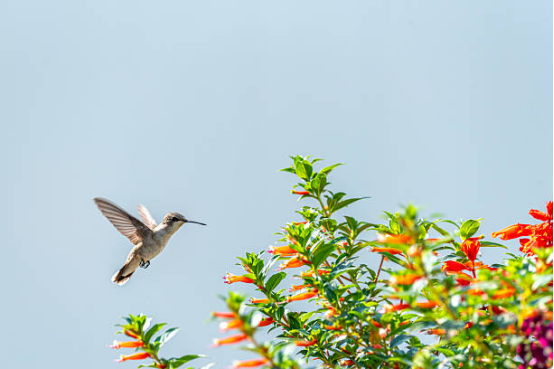
In nature, many flowers that rely on hummingbirds for pollination are red or orange-red and rich in sugar.
- Trumpet-shaped and tubular flowers are most popular with hummingbirds.
- High-sugar nectar provides ample energy
- Red becomes a natural “reward signal.”
Hummingbirds learn to associate red with nectar sources. This conditioned reflex reinforces their preference for red hummingbird feeders.
High contrast improves recognition efficiency
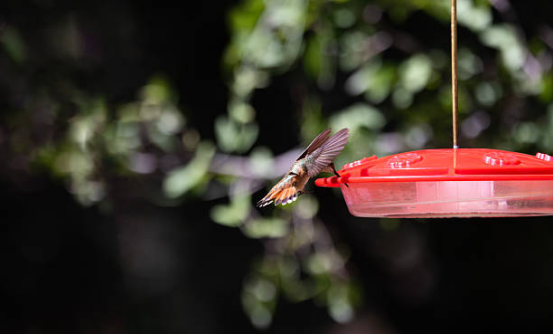
Against a backdrop of green leaves, red flowers or red feeders stand out.
- High contrast makes it easier for hummingbirds to spot their targets.
- Improve foraging efficiency
- The red feeder mimics the signaling effect of natural flowers.
Therefore, choosing a red feeder can significantly improve a hummingbird’s foraging success rate.
Hummingbird Feeder Design Considerations
Why are red feeders the most popular?
There are multiple reasons for the popularity of red feeders:
- Visual guidance: Red is eye-catching and easily recognized by hummingbirds.
- Simulated flowers: mimicking the color of natural red flowers.
- Reduced competition: Red is less attractive to bees
- Reinforcing conditioned reflexes: Hummingbirds learn that “red = food.”
With proper design, the red hummingbird feeder can effectively guide hummingbirds to forage while reducing interference from other insects.
Honey Safety Tips
When choosing a hummingbird feeder, pay attention to nectar safety:
- Do not add red dye.
- The red feeder itself can attract hummingbirds.
- It is recommended to use water and white sugar to prepare the honey solution.
- Clean the feeder regularly to prevent mold growth.
- Avoid prolonged exposure to sunlight to prevent the sugar water from fermenting.
Following these principles can ensure the health of hummingbirds and improve feeding efficiency.
Color Psychology Analysis: Hummingbird Edition
Hummingbirds’ color psychology differs from that of humans.
- Red is a survival signal, not an emotional symbol.
- Visual sensitivity, evolutionary adaptation, and learning and memory work together
- Seeing red will trigger a hummingbird’s foraging behavior.
- Red feeders are more effective than those of other colors because they align with the hummingbird’s natural instincts.
This mechanism explains why the red hummingbird feeder has always been highly recommended in the market.
Creating an ideal feeding environment for hummingbirds
Choosing a feeder is only the first step. To truly attract hummingbirds, a comprehensive consideration of environmental factors is necessary:
- Planting suggestion: Plant red or orange tubular flowers near the Hummingbird Feeder.
- Honey maintenance: Keep it clean and change it regularly.
- Location selection: Place it in a sunny, sheltered spot.
- Feeder height: Adjust according to the hummingbird’s activity level.
- Observe behavior: Record hummingbird habits and optimize layout
By optimizing the environment, the attractiveness of the red hummingbird feeder can be maximized.
Additional advantages of red feeders
- Facilitating long-distance identification: Hummingbirds can quickly spot red targets in the air.
- Reduce false searches: High contrast reduces the time they spend searching for other nectar-free sources.
- Educational significance: The red feeder helps beginners quickly understand hummingbird habits.
These factors make the red hummingbird feeder the top choice for feeding hummingbirds and also give the brand promotion a more scientific basis.
Summarize
Red hummingbird feeders are more attractive to hummingbirds because:
- Hummingbirds have a keen eye for red and a high ability to distinguish warm colors.
- Red flowers typically have a high sugar content, forming a natural “food signal.”
- The red feeder mimics natural flowers, and its high contrast makes it easy to identify.
- Safe usage: Red feeder + water and sugar solution, no dyes added.
- Environmental optimization can enhance attractiveness: plant selection, appropriate location, and regular maintenance.
By scientifically understanding hummingbird vision and behavior, your hummingbird feeder can not only attract more hummingbirds but also ensure their health. Choosing the right red feeder, along with the correct nectar and environmental setup, is key to creating a successful hummingbird corner.