Even a small garden can attract hummingbirds: 5 clever ways to place a hummingbird feeder.

If you have a small garden, you might assume that hummingbirds only frequent larger gardens or rural areas. But that’s not the case! With the right placement of hummingbird feeders and a little ingenuity, even a small garden can become their paradise.
Hummingbirds are light and sensitive; they pay attention to light, location, and even the freshness of sugar water. This article will share 5 practical placement tips to turn your little garden into a hummingbird “secret visitor station.”
Table of Contents
1. Make the Hummingbird Feeder visible and easily discoverable.
This is the most basic step, and one that many people easily overlook. Hummingbirds will only consider stopping if they “see” the hummingbird feeder. If it’s hung too hidden, it might go unnoticed all day.
Practical steps
- Hang it by the window or on the edge of the terrace so you can easily observe it.
- The background should be as bright or a contrasting color as possible, such as a red wall, to attract the hummingbird’s attention.
- If you only have space on the balcony, you can hang the feeder on the railing outside the window, but be careful.
A little reminder
Do not hang the hummingbird feeder behind dense bushes, as this will make it inconvenient for the hummingbird to fly in and out and may also make them feel uneasy. The best choice is a location where it can “see, perch, and fly.”
2. Choose a suitable height for the hummingbird feeder and provide resting branches.
Hummingbirds don’t just come to drink sugary water; they also need a place to stop briefly, observe their surroundings, and rest for a while. A hummingbird feeder of suitable height, along with twigs or thin poles, will significantly increase the number of visits.
Placement suggestions
- Height: Approximately 1.2–1.8 meters above the ground, providing both safety and convenient observation.
- Attached branches give hummingbirds the option to rest or escape quickly.
- Avoid heights that are too high: heights exceeding 2 meters will make hummingbirds feel unsafe and make them difficult to observe.
Tips
When space is limited, you can use thin ropes to hang multiple small branches to form a “jumping platform,” with the feeder hanging in the middle. This gives hummingbirds more choices and makes the display more visually appealing.
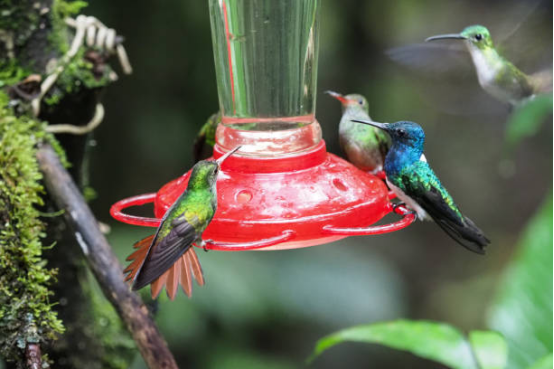
3. A semi-shaded location and keeping the hummingbird feeder syrup fresh
In a small garden, direct sunlight makes the syrup spoil more quickly. A semi-shaded location and regularly changing the syrup are key to attracting hummingbirds.
Operational suggestions
- Hang it in a partially shaded location in the morning or afternoon, such as under a tree or in a shaded area on a terrace.
- Avoid prolonged exposure to direct sunlight, especially during the summer.
- On hot days, fill only half a bottle with sugar water, or move the hummingbird feeder to a shady spot.
Why is it important?
Fermentation or spoilage of sugar water can affect the frequency of hummingbird visits. Just as humans don’t want to keep eating spoiled food, hummingbirds also “remember” places that are not worth staying in.
IV. Hummingbird feeder scattered hanging points close to flowers
Hummingbirds are highly territorial, and fighting may occur if feeders are concentrated in one area. In some small gardens, it might be helpful to set up two feeding spots to create a more natural environment.
Practical suggestions
- If space allows, hang two hummingbird feeders, about 2–3 meters apart.
- bed andThe hanging spots can vary: one near the flower bed, and one near the window, giving the hummingbirds a choice.
- Plant red or warm-colored flowers, such as sage, phlox, or morning glory, near the feeder to provide a natural guide for the hummingbirds.
Small details
flowerpots,Avoid yellow decorations or flower pots, as yellow attracts bees more easily and can interfere with hummingbird visits.
This arrangement not only attracts hummingbirds to the small garden but also makes it more visually appealing.
point and convenientV. Close to observation point + convenient maintenance
The last key point is actually for your own benefit. If the hummingbird feeder is placed in a location that is inconvenient for maintenance or observation, even the most perfect layout may be overlooked.
Operational suggestions
- Hang it at an angle where you often sit or can easily view it, such as on a balcony railing or outside a window.
- Ensure easy disassembly and cleaning.
- Make it a habit: check the sugar water every 2–3 days in summer, and thoroughly clean it every 5–7 days.
Why is it important?
When you are willing to observe and maintain the environment daily, hummingbirds will visit more frequently due to the stable environment. A hummingbird feeder in a small garden can only truly function if you take good care of it.
Summarize
isThe secret to attracting hummingbirds to your little garden is:
- identifiable.The location of the hummingbird feeder is visible and easily identifiable;
- Suitable height and resting branches;
- A semi-shaded environment and fresh sugar water;
- Scattered hanging points + close to the flowers;
- It is close to the observation point and easy to maintain.
Combine these tips, and your small garden can become a hummingbird paradise. Every time you see them hover gracefully, sip nectar, and then elegantly depart, you’ll marvel at how small spaces can be so full of life.
Start setting up your hummingbird feeder and make hummingbirds regular visitors to your home garden!