Hummingbird Feeder Features Comparison Guide: Key Differences You Should Know Before Buying

If you’re hoping to attract hummingbirds to your garden or balcony, a suitable hummingbird feeder is essential. Choosing the wrong one not only wastes time but may also disappoint the hummingbirds and send them flying away. Actually, when I first tried to choose, I was misled by fancy designs, resulting in spilled sugary liquid all over the table. After many trials and research, I’ve summarized some practical functional comparison points to help you choose the most suitable feeder for you.
This article will provide a detailed analysis from four dimensions: capacity and style, materials and construction, cleaning and maintenance, and suction function, and offer practical purchasing advice. Whether you are a beginner or an experienced enthusiast, you can benefit from it.
Table of Contents
I. Capacity and Style: The Primary Factors Affecting Hummingbird Visit Frequency
Hummingbirds are small and have a fast metabolism, making them very picky eaters. A hummingbird feeder of suitable size and design allows hummingbirds to eat easily and reduces the frequency of refilling.
Capacity selection: Larger capacity is not always the best
Generally, feeder capacity ranges from 8 ounces to 32 ounces. Larger capacity reduces the frequency of refills, making it suitable for environments with a large number of hummingbirds. However, in hot weather, the sugar solution is prone to spoilage, and an excessively large capacity can actually increase the cleaning burden.
Practical advice: If your garden is small and you have a moderate number of hummingbirds, a medium capacity of 12–20 ounces is the safest choice.
Style options: Bottle style vs. Plate style
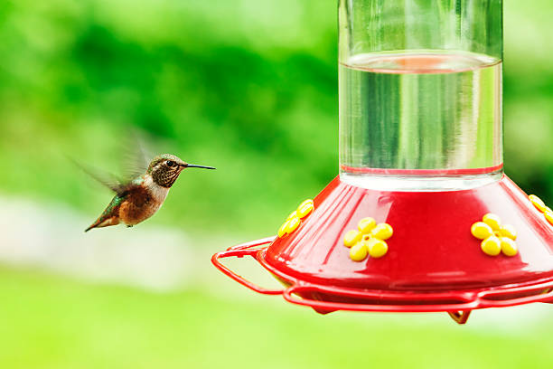
Hummingbird feeder in an inverted bottle shape
- Advantages: The remaining liquid level is clearly visible, and the large capacity makes it suitable for birds or frequent visitors.
- Disadvantages: Complex structure, difficult to clean, and slightly higher risk of leakage.
Disc-type hummingbird feeder (shallow tray or pallet structure)
- Advantages: Easy to clean, sugar solution is easier to replace, and the risk of leakage is low.
- Disadvantages: Smaller capacity, requiring more frequent refills.
Tip: If you want to reduce maintenance time, consider hanging several small-capacity tray feeders, which will both disperse the hummingbirds and make cleaning easier.
II. Hummingbird Feeder Materials and Construction: Safety and Durability Are Equally Important
Glass vs. Plastic
- Glass: durable, beautiful, and does not easily absorb odors, making it suitable for long-term use.
- Plastic: lightweight and inexpensive, but easily deformed by heat, aged, or stained.
Experience sharing: I used the plastic version for two years and found that the color became dull and it was difficult to clean. Although the glass version is more expensive, the visual effect and user experience are significantly better.
Feeding port and insect-proof design
A good feeder should have the following functions:
- beak. The feeding mechanism is smooth and safe, preventing injury to the hummingbird’s beak.
- entering. Ant-proof water tanks or bee-proof openings prevent sugar syrup from entering.
- Easy to disassemble, with few gaps, and easy to clean.
an insect-proof Without an insect-proof design, the sugar solution can easily be taken by bees or ants, which will deter hummingbirds from visiting.
III. Hummingbird Feeder Cleaning and Maintenance: Key to Hummingbird Health
Even the most beautiful hummingbird feeder can become a threat to the health of hummingbirds if it is not clean.
Cleaning tips:
- Check the sugar solution every 2–3 days to see if it is cloudy or contains bubbles;
- brush. Clean the feeding inlet and bottle walls with warm water and a small brush.
- Avoid using strong detergents; instead, soak the affected area in a 1:4 vinegar-water solution.
- Add new sugar syrup after it dries.
Tip: In hot weather, it is recommended to change the sugar solution every day so that the hummingbirds will continue to visit and will not get sick.
IV. Hummingbird Attraction Function: Emphasis on Both Design and Visuals
- Red or warm-colored details: Hummingbirds are sensitive to red and can quickly spot the feeder;
- comfortable. The feeding mouth is shaped like a flower: mimicking natural food sources, making hummingbirds feel safe and comfortable.
- Multiple feeding ports: Suitable for environments with many hummingbirds and frequent visits, but be aware of territoriality, as there may be competition among the hummingbirds.
Interestingly, even with a multi-mouth design, hummingbirds may still only use one mouth if it’s not placed properly. Observing their flight paths and adjusting their positions can significantly increase visitation rates.
V. Hummingbird Feeder Buying Guide
Determine the usage environment
- For areas with prolonged periods of high temperatures: We recommend the glass version or using it in a shaded area. It has a medium capacity.
- refills, choose If you have a large number of hummingbirds or wish to reduce refills, choose a large-capacity bottle.
- cleaning, a For easy cleaning, a tray or wide-mouth design is preferred.
Comparison of structural functions
- Is the feeding nozzle safe and smooth?
- an ant/bee Does it have an ant/bee protection design?
- Removable and easy to clean;
- Does it have red details or a label that says “attracts hummingbirds”?
Budget and Durability
- High-end glass models are slightly more expensive, but they are durable and aesthetically pleasing.
- The plastic version is inexpensive and lightweight, making it suitable for beginners or short-term use.
installation
, observe the frequency of hummingbird visits, whether there is any competition for the feeder, and the remaining sugar solution. If any problems are found, the number or location of the hummingbird feeder can be adjusted accordingly.
VI. Conclusion
Choosing a hummingbird feeder involves more than just price and appearance.
Key points:
- refilling. Capacity and style: Select the appropriate capacity based on the number of hummingbirds and the frequency of refilling;
- Materials and Safety: Glass is durable, and plastic is lightweight; choose according to the environment.
- Insect-proof and structural design: ant- and bee-proof, easy to clean, and protects health;
- Visual appeal: Red details and multi-mouth design increase hummingbird dwell time;
- Cleaning and maintenance: Keep the sugar solution fresh and prevent mold growth.
If you choose the right hummingbird feeder, arrange it properly, and maintain it diligently, hummingbirds will become lively little sprites in your yard, bringing vitality and joy throughout the summer.