5 Maintenance Tips to Extend the Life of Your Hummingbird Feeder

In-depth analysis of why there’s such a big difference between “long-lasting” and “quick-breaking” hummingbird feeders.
If you’ve been using a hummingbird feeder for a while, you’ve likely encountered this phenomenon:
Feeders that look similar can have vastly different performance, with some lasting for years while others develop problems within one or two seasons.
placeIts long-term exposure to the outdoor environment and continuous contact with high-sugar liquids places higher demands on its maintenance.
This article will focus on a core question: how to maximize the lifespan of the feeder without adding complicated steps or frequently replacing the product.
We’ll also ensure the safety of the hummingbirds when feeding.
condition.”Table of Contents
Why is the hummingbird feeder more “delicate” than you think?
Structurally, the hummingbird feeder is not complicated.
But the problem lies precisely in the usage environment.
“High-sugar liquids combined with outdoor environments create a ‘high-loss combination.'”
Sugar water is a primary energy source for hummingbirds, but it becomes a continuous burden for the product:
- Sugar water is prone to fermentation.
- A sticky residue is produced after fermentation.
- Residue can adhere to the feeding opening, seals, and internal channels.
Add to that sunlight, temperature differences, rainwater, and microorganisms in the air.
Any detail that is not properly maintained will be magnified.
suddenly, but This is why problems with hummingbird feeders often don’t appear suddenly but rather “get worse slowly.”
Tip 1: Make “cleaning” a habit, not a remedy.
Many users make the same mistake when cleaning their hummingbird feeder:
Waiting until it “looks dirty” before they start cleaning.
However, in reality, the sugar solution has often undergone multiple rounds of changes by this time.
Why does sugar water spoil faster than you think?
In environments above 30°C, sugar water can begin to ferment within 48 hours.
Even if it appears clear, its internal odor and chemical state have already changed.
Once fermented:
- Cleaning difficulty increased.
- Internal residues are more likely to adhere.
- The hummingbird feeder’s materials began to experience additional stress.
A more reasonable cleaning rhythm
Instead of conducting a “deep cleanup” occasionally, it’s better to establish a fixed frequency:
- Summer or high-temperature environments: every 2–3 days
- Spring and autumn: every 4–5 days
- Continuous exposure to sunlight: shorten the cycle
Key details in practical operation
- Use warm water, not hot water.
- Clean the feeding port with a soft brush.
- White vinegar is only for short-term soaking and should not be used for extended periods.
In the long run, this seemingly “troublesome” habit can actually make hummingbird feeders more worry-free.
aesthetics butTip 2: The hanging position is not just a matter of aesthetics, but also a matter of lifespan.
The aging of many feeders is actually partly determined when they are first deployed.
The real impact of full-day sun exposure on feeders
Prolonged exposure to direct sunlight can lead to several chain reactions:
- The molecular structure of plastic parts accelerates aging.
- Decreased elasticity of the sealing ring.
- The temperature of the sugar water remained too high.
The result is that you’ll clean more frequently, but you’ll find that the problems actually increase.
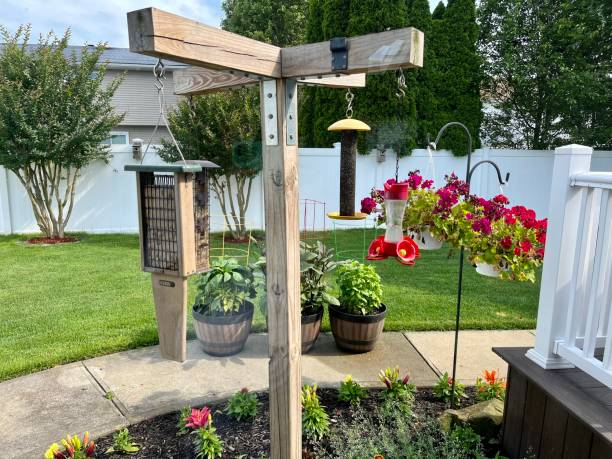
What conditions should an ideal suspension environment meet?
- The morning sunlight makes it easier for hummingbirds to spot.
- The afternoon provides shade to lower the temperature of the sugar water.
- Good air circulation, but avoid strong winds.
This environment is a long-term stable condition for both hummingbird feeders and hummingbirds.
Tip 3: The sugar ratio is not a matter of “preference,” but rather a matter of structural safety.
Many people might think, “Hummingbirds would prefer something sweeter.”
But considering the lifespan of a hummingbird feeder, this is a high-risk judgment.
The significance of standard proportions
sugar to 4The standard proportion for sugar water is 1 part white sugar : 4 parts water.
isThe advantage of this ratio is:
- It does not easily crystallize.
- Easy to clean.
- More user-friendly for feeding openings and internal passageways.
Long-term damage of incorrect sugar water to hummingbird feeders
- Crystallization blockage.
- Increased cleaning frequency.
- Accelerated material fatigue.
fine butUsing the wrong proportion of sugar water over a long period of time will often make the feeder “look fine, but become increasingly difficult to use.”
Tip 4: Small parts determine long lifespan
Almost all hummingbird feeders that “suddenly leak” have shown previously ignored signs before the leak occurred.
Three most easily overlooked parts
- Has the sealing ring hardened?
- Is the feeding port slightly deformed?
- Are the hooks starting to rust?
If these problems are addressed promptly, they usually only require the replacement of a small component.
However, continued use often leads to irreversible structural damage.
Tip 5: Seasonal storage actually helps “restore the feeder to its original condition.”
The lifespan of many feeders is not actually shortened during use but rather destroyed during storage.
Three things that must be done before storing
- Complete cleaning.
- Dry thoroughly.
- Disassembly and decompression.
Common consequences of incorrect storage
- Mold residue inside.
- Seal adhesion and deformation.
- Material aging at high temperatures.
Properly storing your hummingbird feeder for a season is equivalent to “pausing losses.”
In conclusion, what truly extends the lifespan of a feeder is a systematic set of habits.
If we only remember one conclusion, it is this:
The lifespan of a hummingbird feeder depends not on how perfectly it performs once, but on how consistently it performs over the long term.
Regular cleaning, proper hanging, correct sugar dosage, timely inspection, and proper storage—
These seemingly ordinary actions determine how long a feeder can stay with you.
FAQ: Frequently Asked Questions about Hummingbird Feeder
Q1: Why does the feeder always get dirty?
Because sugar water itself is a high-risk medium, and the frequency of cleaning must be controlled.
Q2: Can the feeder be used year-round?
It is recommended to remove it and store it properly after the hummingbirds have finished their migration.
Q3: How long can a hummingbird feeder be used normally?
With proper maintenance, 3–6 years is not uncommon.